The truth is being a big fish in a small pond comes with many advantages. Being an "A" student with high standardized test scores in a public high school can help your child stand apart. In addition to all of the extra attention you'll get from teachers as one of the building's superstars, you'll also be able to bring the tangible credential of class rank to the college admissions table. Many of the most selective colleges in the country draw the bulk of their freshman from the top-10% of high school classes.

For example, at Swarthmore 93% of first-year students were top-10 finishers, at MIT this figure is 95%, and at Washington University in St. Louis "only" 84% earned this designation. Now, most elite private schools can get around this by not submitting class rank information, but those students do not escape being ranked against their classmates who are applying to the same elite schools. In contrast, public school students usually deal with far less internal competition at particular colleges during the application process. If Duke is your dream school, and you have the stats that make you a strong applicant, you don't have the added worry of having to edge out the seven prospective Blue Devils within a row of you in Calculus class. As you see, the average acceptance rate for these elite private high schools to the Ivies is approximately 33%.

Private universities are more selective about whom they admit and often have more stringent admissions standards than public universities, which cater to a larger, wider range of students. With smaller student populations and lower acceptance rates, the average student likely won't be able to get an education at the elite institutions. Out of all the ranked schools, the top private institutions accept the fewest applicants. The only way an investment in private college can potentially pay off is if students do their homework to find a school that fits their academic interests and social needs—which vary significantly from person to person. Some schools, like the University of San Diego and Bryn Mawr College, boast gorgeous campuses and idyllic settings to inspire learning. Other private colleges, like the Massachusetts Institute of Technology, offer phenomenal engineering and science programs to help students excel in competitive fields.

While other institutions, like Whitman College, promise a well-rounded liberal arts education and endless opportunities to apply it to the issues students care about most. There is a common belief out there that students hailing from private high schools have better odds of getting into Ivy League colleges. There are many folks who believe that if they don't send their children to fancy private schools, they will be at a significant disadvantage when they apply to Harvard, Dartmouth, Princeton, and Brown.

Students hailing from private schools do not have better odds of getting into highly selective colleges — like the Ivy League colleges — than students hailing from public schools. Legacy, donor, and athletic preferences should be stripped out of college admissions too, but when it comes to tipping the scales away from fairness and equity, private schools outweigh everything else. Dr. Lowe also helps students gain admissions into their top choice private schools and colleges after they have been wait-listed and rejected.

Dr. Lowe and his Greenwich Admissions Advisors team provide house-calls for families with extremely busy schedules who can't come to their office. These highly prestigious private universities are known for their top-notch academic programs, as well as their hefty tuition rates. Many students dream of attending one of these schools, but the low acceptance rates make it tough to obtain an Ivy League education.
Many independent school counselors started in college admissions, often at highly selective colleges; one of the newest members of this rank was a dean of admissions at an Ivy League university just last fall. These high schools are paying not just for experts who know the rules of the game; they are paying for experts who know the referees. Let's start with some assumptions here…Your local suburban public high school has a solid reputation. It offers Advanced Placement courses including AP Computer Science and a host of science, social studies, and foreign language options.

The average SAT score at your local school in somewhere between 1000 and 1100. The top 10% of students in each graduating class head to a mix of state schools, often on heavy merit scholarships, as well as to at least a handful of highly-selective institutions. The valedictorian last year was accepted to Stanford and the salutatorian earned acceptance out-of-state at UVA.
If you live a middle/upper-middle class lifestyle in Nice Suburb, USA, then this description is likely somewhere in the ballpark of your local public high school. Clearly attending a school of Harvard-Westlake's ilk can put you in good standing come admissions time. The counselors at these schools are on a first-name basis with admissions offices at the finest universities in the country and that can undoubtedly work to your advantage.

On the other hand, being an "A" student with high standardized test scores amidst a sea of comparable, or even superior students, can be a harrowing experience. One could argue that there is value in learning to walk with giants—after all, law school, med school, or a high-powered job in a Fortune 500 company will involve just that. There may be validity to this line of thinking, but one must also recognize that not every kid is ready to be thrust into cutthroat academic competition at the tender age of 14 or 15. Further, despite the success of the class at large, if your kid was the 7th most talented University of Pennsylvania-hopeful at Harvard-Westlake, they may have been handed a rejection letter. At a less competitive public or private high school, it's quite possible their Quaker quest would have ended differently, assuming they possessed the same test scores and placed near the top of their class.

Private schools typically have higher tuition prices, frequently resembling the price of tuition and fees for out-of-state students at public universities. But private schools often offer generous financial aid packages to help students afford their education. To help narrow down options, Stacker compiled a list of the best private colleges in America, using data from Niche released in 2021. Niche ranks schools based on a variety of factors including academic, admissions, financial, and student life. Although Cornell University has the highest acceptance rates of all Ivy League schools, this does not mean that it's an easy school to get into. To be a competitive applicant for any of these eight prestigious institutions, you cannot slack off when it comes to your applications.

Start planning your acceptance strategies early, which means studying hard at school and planning ahead for your standardized tests. If you have not been involved in an extracurricular activity since childhood, plan to seriously commit to an activity as early as you can. Choose something you love to do as this will be evident in your application components.

Most importantly, do not choose to go to an Ivy League school for appearances. Choose a program you actually want to attend and graduate from, rather than a program that will look good on your CV. Prestige and social status do not necessarily translate into better educational fit for you. Choose happiness and invest in your education in a school you truly want to attend. Located on Manhattan's Upper West Side, Trinity is notably at the top of the list. The institution was founded more than 300 years ago as a school for the poor and was originally supported by charity.

Its classes are considered the best in the nation, with its core curriculum focused on "inquiry-based" learning. Catering to grades K-12, Trinity now has an average enrollment of 960. The senior class is compromised of 113 students, 28% of which receive financial aid. Of the 214 students who took Advanced Placement classes in 2013, 93% received grades of 3 or higher. Approximately 41% of its graduates attended prestigious Ivy League colleges. Each Ivy League college has its own unique accomplishments that make it important.

All carry a certain reputation with them, and each school has programs that excel primarily in the medical and law fields, making them some of the most sought-after schools in the world. Their admissions process is very selective, which helps the schools ensure that they only accept the best and brightest. Many famous people have graduated from Ivy League schools, including recent presidents George W. Bush, Bill Clinton, and Barack Obama. This prestige leads many to believe that these colleges are only for the wealthy and elite. Often, companies look for Ivy League graduates as potential employees, usually preferred by law firms, medical facilities, and large corporations. It has long been coveted to have earned a degree from an Ivy League school.

Today, there are other competitors that some claim to be just as good as their Ivy counterparts. Some of these well-known schools include Duke University, Johns Hopkins, MIT, Vanderbilt, and Georgetown University, to name a few. The Ivy League schools are still excellent in both academia and in sports, and they have left a legacy of higher education with an exceptional track record and reputation to go along with them. Most independent schools do provide some financial aid, but it often goes to a small share of students.
At Marlborough, an independent school in Los Angeles where the cost of attendance is about $45,000, only 20 percent of families receive financial aid, and almost half of those who do still make more than $200,000 per year. About 6 percent of all the school's students come from families making less than $100,000, even though almost two-thirds of American households make less than that. If you're living in the same state as a Public Ivy—or can establish residency near your school of choice before college—it's probably themost affordable wayto get an outstanding education. Nonetheless, you'll want to apply to a variety of colleges, including some public schools that are lower on your list and private schools that may be a financial or academic reach. Liberal arts colleges, both private and public, are located all over the United States.

If you prefer to live in a certain part of the country or want to stay close to home, the location of Ivy League schools might be a consideration. Because all Ivy League schools are private universities, tuition costs are higher for students compared to their in-state public tuition alternatives. However, Ivy League schools also have the reputation for being generous with financial aid due to their large endowments.
Harvard University is probably the most well-known Ivy League school. It is located in Cambridge, Massachusetts, and is a medium-sized school with around 7,000 undergrad enrollments. Harvard is also a very competitive school as the acceptance rate is only 5%.

Accepted students' SAT grades typically range from 1460 to 1580, and their ACT grades range between 33 and 35. Harvard is rated #1 for biology studies and political science studies according to Niche's 2020 Best Colleges. University of the People is a member ofHarvard Business School Online's (HBS Online's) Collaborating Colleges program.

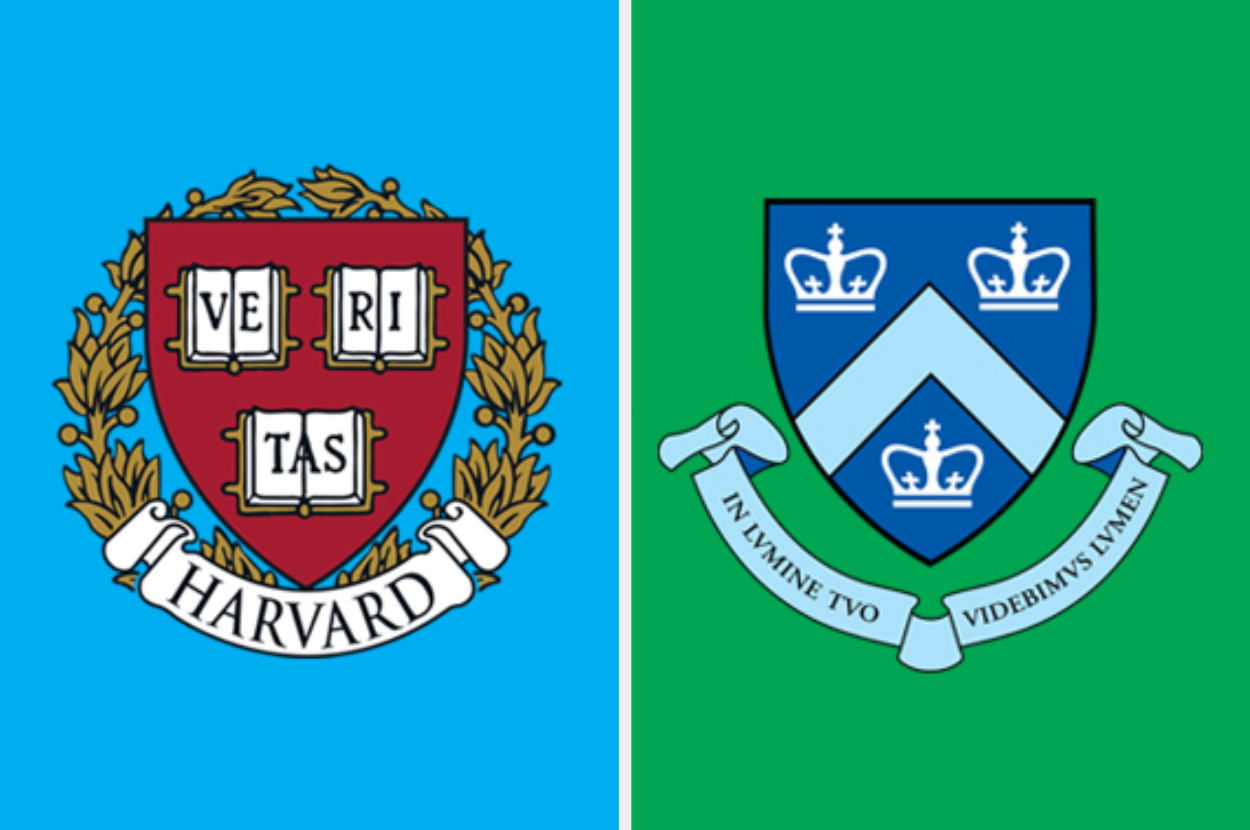
Harvard Business School Online offers a unique and highly engaging way to learn vital business concepts via an innovative online platform that brings the Harvard Business School classroom to you. Admission to elite universities has become increasingly competitive. Each year, Ivy League schools and other top colleges advertise their low acceptance rates as a badge of honor. In 2019, Harvard and Columbia accepted a record low number of applicants. This exclusivity creates a vicious cycle; the more selective schools are, the more students and parents want in. Carnegie Mellon University has renowned science and technology programs, along with seven schools and colleges for a well-rounded liberal arts education.

A global research university, the school offers opportunities for students to participate in hands-on learning with an award-winning faculty. They take the time to get to know applicants and select those who they think will take advantage of Columbia's community and offer a meaningful contribution to the community. Columbia offers generous financial aid programs to qualified students. Fourth, admissions offices should redact the name of the school during the admissions process and stop assigning applications by region, as most highly selective colleges do. Context is essential for admissions officers to consider applicants' merits rather than their accomplishments. A file could still contain relevant information about a high school, such as the number of students on free lunch programs, or its student-to-counselor ratio.

Going school-blind would not erase context, but it would hide the brand names. Ivy League schools have a reputation for being elite institutions, with high selectivity during the admissions process. Harvard University is currently the most selective university in the country. Out of 57,435 applications received for the Class of 2025, Harvard admitted only 3.4 percent of applicants.

While the admissions process is extremely selective, it is not impossible for first-generation students to earn a spot in these world-class schools. For example, 16 percent of Yale's Class of 2025 are the first member of their family to attend university. However, the Ivy Leagues have recently come under fire for their admissions processes, which critics say favors legacy students to the detriment of minority students. It is easy to say "plan ahead", but there is a lot of advantage in knowing what school and program you would like to attend in the future. If you are certain about which school you want to enroll in, it might be wise to apply through the Early Action/Early Decision program. This way, your deadline for application is earlier, but so is your response date.

Are All Ivy League Universities Private To utilize this opportunity, you must research your school of choice and determine whether you are a good fit for the program to which you're applying. Early Action programs give you an early answer as to where you stand in the admissions process. According to most recent data, Cornell's acceptance rates for their early decision program is 22.7%! Graduates of Ivy League schools can expect high average early career salaries and low total debt upon graduation due to the universities' extensive student grant and financial aid packages.

Ivy League educations are prominent in the upper echelons of American business, with nine members of the 2021 Forbes 500 list having attended an Ivy League school. As of 2019, Harvard University had the most billionaires attend at 1,830 , and the prestigious university could also boast about having the most presidents attend, including both Roosevelts and John F. Kennedy. Now, maybe you think this methodology is bad, and they should have looked at other stuff, like graduation rates, indebtedness, time to graduation, and so on.

News has its own ranking that takes some of these things into account, and their top performers are a bunch of public colleges and HBCUs that tend to educate a bunch of Hispanic and Black kids. CollegeNET has yet another ranking, and it's dominated by Cal State and CUNY. Which private schools send the greatest percentage of their students there? Here's our list of the Top 14, with an average acceptance rate for those elite universities of about 33%.

It's likely no surprise that Ivy League-level colleges and universities would borrow a little "ivy" to use in their own names. These similarly prestigious groups of institutions include public schools, small liberal arts colleges, and other lesser-known, top-tier schools. The student body is a diverse mix of talented, open-minded, and empathetic individuals. Study Cornell's culture and university philosophy to determine if you're a good match.

Graduating from private high school is a far larger advantage at many top ranked colleges than playing sports or being a legacy or even having a connection to a donor are. If we really wanted to get rid of the most glaring case of bias at prestigious private universities, we would target private high school students. You are essentially getting an elite private school education free of charge . If your local public school option isn't strong, and your child is accepted into a magnet school of this quality, then attending is a no-brainer. However, if your public options are good , the choice becomes murkier.
With that, let's switch gears and look at the benefits of attending a top "pure" public institution. Even though Ivy League schools have impeccable reputations, they do not produce the most students who ultimately earn doctorate degrees. According to a 2010 CBS Money Watch report, liberal arts schools dominated the top 10 list of students who eventually earned doctorates. For example, liberal arts schools produced twice as many students with science doctorate degrees as compared to other institutions, including Ivy League schools. If you are planning to pursue a doctorate, you might look beyond Ivy League possibilities and examine additional opportunities.


